
 Deutsch
 English
 Español
 Polski
 Türkçe
 Русский
Dengue is the fastest-growing viral disease, and is spread by mosquitoes that are active during the day.1,2 Every year, an estimated 400 million people are infected worldwide.1 In Germany, an ever increasing number of returning travellers are diagnosed with dengue fever.
Dengue in brief.
- Dengue is transmitted throughout the year in tropical and subtropical regions. However, localised cases of dengue are increasingly being reported in Spain, France, Italy and on Madeira.3
- There are four different dengue viruses, and you can be infected with dengue up to four times.4
- Symptoms of dengue can include high fever, headache and aching limbs, and skin rash.1
- A second infection may be more severe than the first,1 although severe symptoms are possible even with the first infection.5
- Around a third of dengue patients reported in Germany between 2013 and 2023 required hospital treatment.6
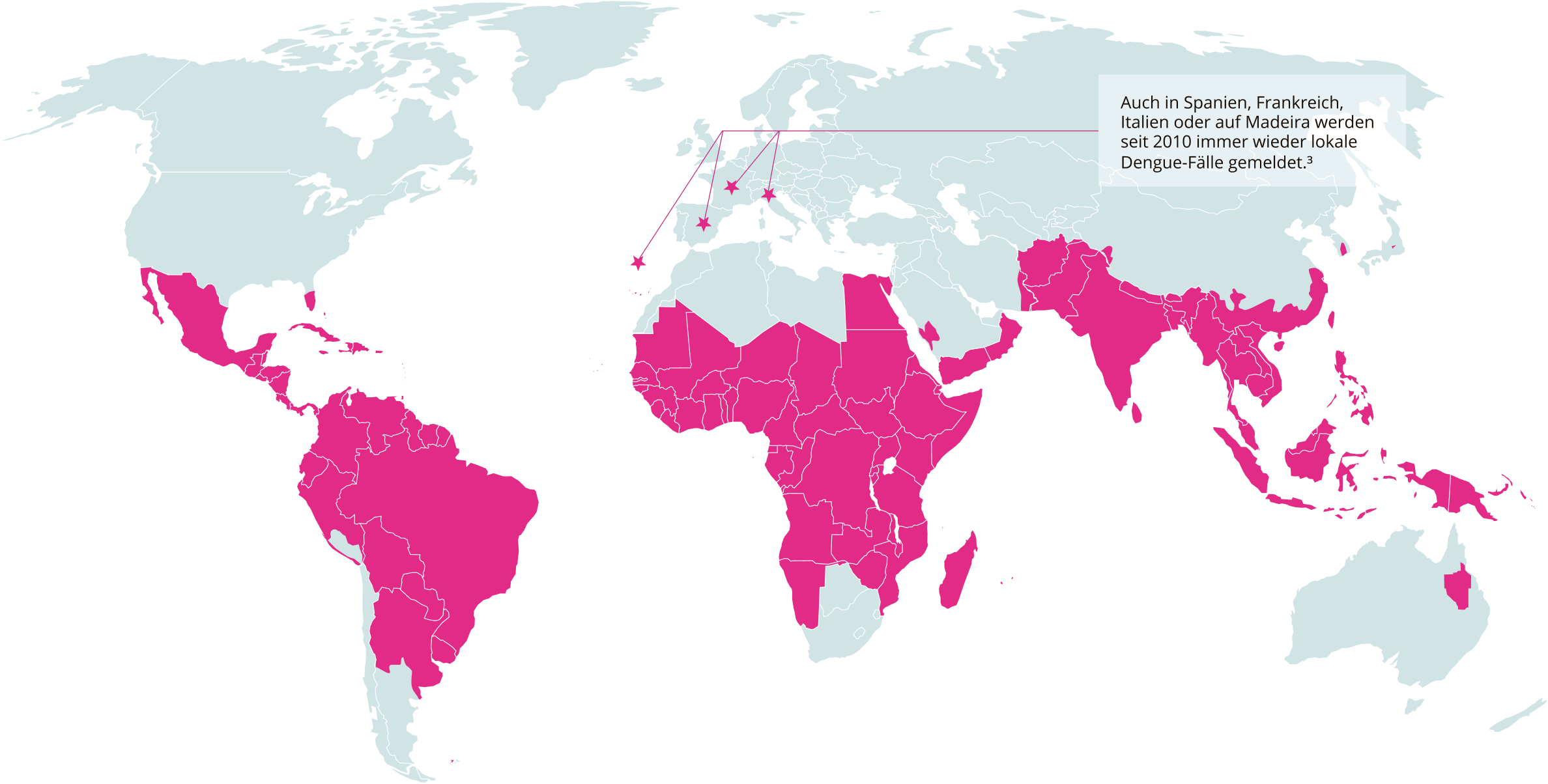

What you need to know about dengue
Talk to a travel health specialist about dengue prevention.
How you can protect yourself when travelling.1
- Ideally, wear long-sleeved, light-coloured tops and long trousers.
- Protect exposed areas of skin with insect repellents. Mosquito sprays containing DEET are best.
- Always sleep under a mosquito net that's long enough to tuck under the mattress.
- You should spray a suitable insect repellent on your clothes and mosquito nets too.
What should you do if you get infected?1
If you develop a high fever during or after a visit to a tropical or subtropical region, this may be a sign of dengue. You should see a doctor if you develop two of the following symptoms in addition to fever:

Headache and aching limbs

Pain behind the eyes

Muscle and joint pain

Nosebleed and bleeding gums
Persistent vomiting

Itchy rash
Dengue can develop into a potentially life-threatening illness that needs to be treated in a hospital, although this is very rare.7


 Quellen
- World Health Organization. Dengue Fact Sheets. https://www.who.int/news-room/fact-sheets/detail/dengue-and-severe-dengue. Letzter Zugriff: Oktober 2025.
- World Health Organization. News. Dengue: fastest growing mosquito-borne disease in the world, https://www.who.int/news/item/29-10-2010-dengue-the-fastest-growing-mosquito-borne-disease-in-the-world. Last accessed: October 2025.
- Robert Koch-Institut. Weltkarte der Gebiete mit kontinuierlicher Übertragung von Dengue-Viren, https://www.rki.de/DE/Themen/Infektionskrankheiten/Infektionskrankheiten-A-Z/D/Dengue/Karte.html. Last accessed: October 2025.
- Heinz et al. Vaccine 2012; 30:4301-6.
- Nunes, PCG. et al. BMC Infect Dis. 2018;18(1):346.
- Robert Koch-Institut. Infektionsepidemiologische Jahrbücher meldepflichtiger Krankheiten 2013-2023. https://www.rki.de/. Last accessed: October 2025.
- Steffen, R. et al. J Travel Med. 2023;30(7):taad085.
EXA/DE/DENV/0418